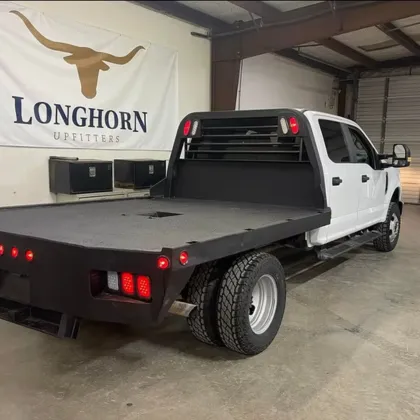
The Evolution of Flatbeds in Commercial Vehicles: What Businesses Need Today
Commercial work trucks have changed dramatically over the years, and the equipment installed on them has evolved right alongside them. One of the most recognizable and versatile pieces of commercial truck equipment is the flatbed.
What began as a straightforward platform for hauling materials has developed into a highly configurable work-truck solution. Today's flatbeds can incorporate towing equipment, toolboxes, storage, lighting, headache racks, tie-down points, and other features designed around specific industries and applications.
For contractors, landscapers, construction crews, agricultural operations, utility companies, and fleet operators, choosing the right flatbed can transform a standard chassis or pickup into a more capable work vehicle.
At Longhorn Upfitters in Arlington, Texas, we provide flatbed installation, refurbishment, and commercial truck upfitting services for businesses throughout the Dallas–Fort Worth area.
How Flatbeds Became a Commercial Work-Truck Staple
The basic concept behind a flatbed is simple: provide an open, accessible cargo platform without the restrictive sides of a conventional pickup bed.
That simplicity is also what makes flatbeds so versatile.
Traditional pickup beds work extremely well for everyday transportation, but commercial operators often need to move equipment and materials that don't fit neatly between conventional bedside walls.
Flatbeds provide greater access to the cargo area and can make loading certain materials from the sides or rear considerably easier.
Over time, flatbeds evolved from basic hauling platforms into specialized pieces of commercial truck equipment.
Modern Flatbeds Are More Than a Cargo Platform
Today's commercial flatbeds can be configured with features designed to improve productivity, storage, towing, and accessibility.
Depending on the truck and intended application, a modern flatbed may incorporate:
Integrated toolboxes and storage
Headache racks
Stake pockets and removable sides
Tie-down locations
Gooseneck towing provisions
Receiver hitch compatibility
Trailer electrical connections
LED work and safety lighting
Mud flaps
Heavy-duty rear aprons
Side steps
Equipment mounting provisions
Additional commercial accessories
Rather than simply replacing a pickup bed, the right flatbed can become the foundation for an entire work-truck configuration.
Why Businesses Choose Flatbeds
Easier Cargo Access
One of a flatbed's biggest advantages is accessibility.
Without traditional pickup-bed sides restricting the cargo area, equipment and materials can often be loaded from multiple directions.
That can be particularly useful when working with forklifts, pallets, construction materials, landscaping equipment, oversized cargo, and other commercial loads.
Greater Cargo Versatility
Commercial businesses rarely haul the exact same thing every day.
A contractor might carry lumber one morning and equipment the next. A landscaping company might transport tools, materials, pallets, or machinery depending on the job.
An open flatbed gives businesses greater flexibility when the type and size of cargo regularly changes.
Towing Capability
Towing is an important part of many commercial operations.
Depending on the flatbed, truck, and configuration, the setup may accommodate bumper-pull towing, gooseneck applications, trailer electrical connections, and other towing equipment.
However, installing a flatbed does not automatically increase the truck's factory towing or payload ratings. The vehicle's GVWR, GAWR, payload, hitch ratings, and manufacturer specifications still matter when determining what the completed truck can safely carry or tow.
Built Around the Job
Modern flatbeds can be configured around specific business requirements.
A landscaping company may prioritize accessibility and cargo capacity.
A construction company may need tool storage and towing capability.
An agricultural operation may prioritize durability and the ability to carry irregular loads.
A fleet operator may value standardized equipment across multiple trucks.
That's what makes flatbeds particularly useful in commercial applications: the truck can be configured around the work instead of forcing the work around the truck.
Steel vs. Aluminum Flatbeds
One of the decisions businesses may encounter when selecting a flatbed is the material.
Steel Flatbeds
Steel has long been a popular choice for commercial work trucks because of its strength and durability.
Steel flatbeds are commonly used in demanding environments where equipment regularly experiences heavy commercial use.
Depending on the design, steel can also provide considerable flexibility for fabrication, repair, and modification.
Aluminum Flatbeds
Aluminum provides another option for businesses looking at commercial flatbeds.
Its lower material weight can be beneficial in certain applications, particularly when overall vehicle weight and available payload are important considerations.
Aluminum also offers strong corrosion resistance, which can be valuable for trucks regularly exposed to weather and demanding environments.
Neither material is automatically the right answer for every truck.
The best choice depends on the vehicle, application, expected loads, environment, budget, and equipment that will eventually be installed.
Flatbeds for Different Industries
One reason flatbeds have remained popular is the number of industries that can use them effectively.
Construction and Contracting
Flatbeds can make it easier to transport lumber, equipment, materials, generators, tools, and other jobsite supplies.
Landscaping
Landscaping companies regularly transport equipment and materials that benefit from an open cargo platform.
Flatbeds can also serve as the starting point for more specialized landscape-bed configurations.
Agriculture and Ranching
Farm and ranch trucks frequently need to transport feed, fencing materials, equipment, tools, and irregular cargo.
The accessibility of a flatbed makes it a practical solution for many agricultural applications.
Utility and Field Service
Commercial fleets and field-service operations can configure flatbeds with storage, towing equipment, lighting, and other accessories according to their operational requirements.
Choosing the Right Flatbed for Your Work Truck
The best flatbed isn't necessarily the largest or most expensive one.
It's the one that properly matches the truck and the work being performed.
Before selecting a flatbed, businesses should consider:
Truck year, make, and model
Cab-to-axle dimensions
Chassis configuration
Single-rear-wheel or dual-rear-wheel setup
GVWR and payload limitations
Flatbed dimensions and weight
Expected cargo
Towing requirements
Gooseneck requirements
Storage requirements
Lighting and electrical equipment
Toolboxes and accessories
Future equipment additions
Proper fitment matters just as much as the flatbed itself.
Why Professional Flatbed Installation Matters
Installing a commercial flatbed involves more than removing a pickup bed and setting another body on the frame.
A proper installation may involve mounting and alignment, lighting, trailer wiring, fuel-filler positioning, hitch equipment, clearance considerations, mud flaps, cameras, sensors, and other vehicle-specific components.
Poor installation can create problems with fitment, electrical systems, equipment clearance, or everyday usability.
Professional installation helps ensure the flatbed and related equipment are configured appropriately for the vehicle and intended application.
Don't Overlook Flatbed Refurbishment
A commercial flatbed doesn't necessarily need to be replaced simply because it has years of service behind it.
Depending on its structural condition, refurbishment may be an option.
Flatbed refurbishment can involve addressing worn or damaged components, repairing fabrication, restoring surfaces, replacing accessories, and preparing the bed for continued commercial use.
For businesses managing multiple trucks, refurbishing usable equipment can sometimes be a practical alternative to replacing the entire body.
Longhorn Upfitters provides flatbed refurbishment services in addition to new flatbed installations.
Build the Flatbed Around Your Business
Flatbeds have evolved because commercial businesses have evolved.
Today's work trucks need to haul more than cargo. They may need to tow trailers, organize equipment, support crews, accommodate specialized tools, and perform reliably across demanding jobsites.
That's why selecting the right flatbed should start with one question:
What does your truck actually need to accomplish every day?
Once that's understood, the flatbed and its accessories can be configured around those requirements.
Flatbed Installation in Arlington and DFW
Located in Arlington, Texas, Longhorn Upfitters provides professional flatbed installation, refurbishment, fabrication, and commercial truck upfitting services for customers throughout the Dallas–Fort Worth area.
Whether you're converting a pickup into a work truck, replacing an existing truck bed, refurbishing an older flatbed, or building out a commercial fleet, our team can help determine the right equipment and configuration for your application.
Ready to Upgrade Your Work Truck?
Contact Longhorn Upfitters today to discuss your flatbed installation, refurbishment, or commercial truck upfitting project.
